

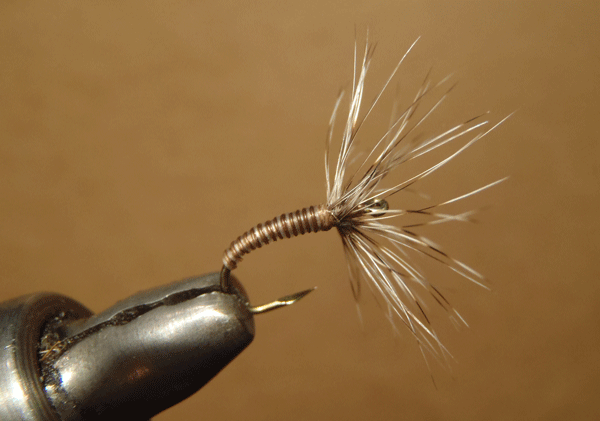
That’s right–I said “horsehair tenkara FLIES”, not “horsehair tenkara LINES”. Usually, whenever you combine the words “horsehair” and “tenkara” in the same sentence (or Google search), the discussion is inevitably around horsehair tenkara fly lines. But what many people don’t know is that horsehair (or, more accurately, horse tail) also makes an excellent body material for sakasa kebari.
Horsetail usually comes in a hank that has mixed strands of light and dark colors. By wrapping one light and one dark strand together, it produces a nicely segmented body with very buggy looking variegation.
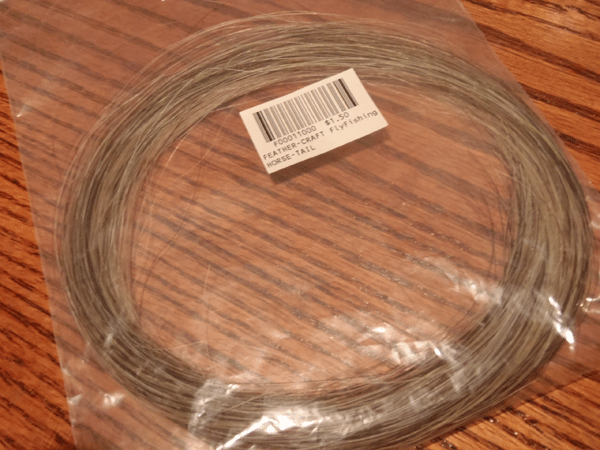
It’s often tapered and to select the right thickness of the section of tail to use, you need to consider the size of the fly you’re tying. Also, take into account that the thinnest part of the tail will be more brittle and might break after you tie it in and start wrapping it along the hook shank. If you need the very thinnest part for very small flies, you can counter this by soaking the fibers in water to soften them up. But I find that for tenkara flies, I can usually get away with the medium diameter of the fibers and it wraps just fine.
To build a tapered body, tie in the thinnest part first and wrap an underbody of thread that is thicker near the thorax. Then, when you wrap the horsehair forward, the combination of underbody and progressively thickening horsehair will give you a good taper. Here’s one recipe for a horsehair tenkara fly that is a good all around sakasa kebari but feel free to substitute with your favorite hackle, hooks, thread colors, etc.
Horsehair Sakasa Kebari
Hook: TMC 2499SPBL #14
Thread: Uni 8/0 Camel
Body: 2 strands of horse tail–one light, one dark wrapped together
Hackle: Grizzly
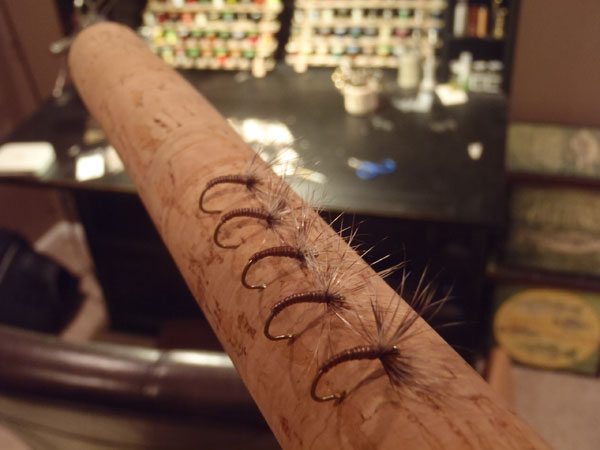


Very nice. Chris gave me some extra horse hair line in tan that made a nice fly. Just like yours.
Hi Jason. Curious as to where you find your horse hair? Craft stores or local fly shops don’t seem to have it – do you have an online source?
Thanks Greg
Hi Greg, I got mine from Chris Stewart at Tenkara Bum. I don’t know if he still sells the kits or not but you should ask him. Even if he doesn’t sell them anymore, he’d know where to get them.
You can purchase horse hair from any luthery supply (think violin bows), Met Music, Lmi, ebay even sells it. Horse hair in single hanks for a violin bow can be had for only a few dollars and will supply you with enough to even make a short furled leader. Most local violin shops will have it on hand and would probably give you some. Avoid used horse hair from a violin bow however as it will be well impregnated with rosin by the time you get it, although now that i think of it there is a chance that it would act as a ready floatant. . thank you for the tip.. didn’t think of using it to make flies. I’m going to try that next. (I am a violin maker here in golden, co)