

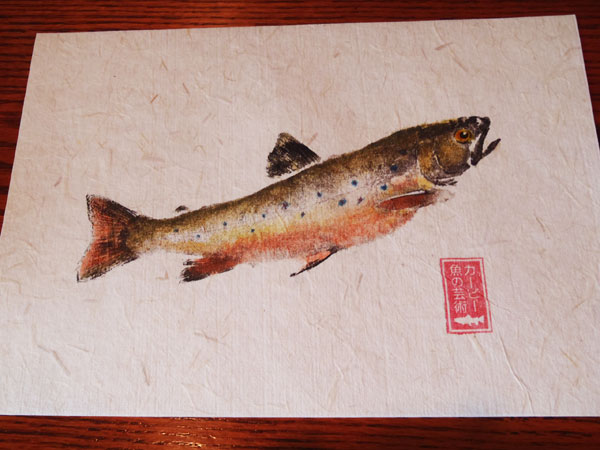
Today, I received my long awaited gyotaku print! In Japanese, “gyo” means “fish” and “taku” roughly translates to “rubbing”, so “gyotaku” could be translated as “fish rubbing”. Basically, the process involves painting a fish (literally), then laying a piece of washi paper over it, rubbing it to transfer the ink (or paint) to the paper, and finally touching it up (painting in the eye, adding a hanko, etc.). In the early-to-mid 19th century, gyotaku was a merely a method for recording the size of fish caught by commercial fishermen. It has since evolved into an art form and what I got today is truly a piece of art…
Over the years, fly fishing has given me a deeper appreciation of aesthetics. It’s taught me to recognize beauty in microscopic worlds that the casual passerby would miss–the backlit glow of a mayfly’s wing drifting on the surface of the water at dusk, the seemingly impossible intricate engineering of a dried out stonefly shuck left behind on a rock, the warfare between prolifically hatching aquatic insects trying to escape both the fish and birds that seem to seal their fate but just happen to somehow win by numbers and make it to the trees to start the cycle of life all over again. Most of these things are invisible to the uninitiated, but the fly angler sees the “invisible” world and that is one of the main reasons I love our sport.
Tenkara has helped me appreciate that sense of aesthetics even more. Not only on the stream, but also in art. Gyotaku prints are simple and focused. Just the fish and the stamp of the artist that created it. All handmade, in a simple process. And an embrace of wabi-sabi. When you paint a picture of a fish, you can make it look perfect–like a supermodel. But real fish (and really beautiful fish) have flaws and imperfections. Each imperfection is unique and doesn’t betray their beauty, but enhances it. Gyotaku captures the beautiful imperfection of each individual fish and turns it into art. And that’s why I cherish it.
Mine was made by Kirby Wilson, a Canadian tenkara angler and gyotaku artist living in Finland. Kirby makes one-of-a-kind gyotaku prints in the traditional Japanese method. If you like this style of art, then you should definitely check out his site Fresh Catch Gyotaku. His work is amazing and his prices are unbelievably reasonable considering how much work goes into each one and the fact that each one is 100% unique.
Here are some more pictures of the piece I got:
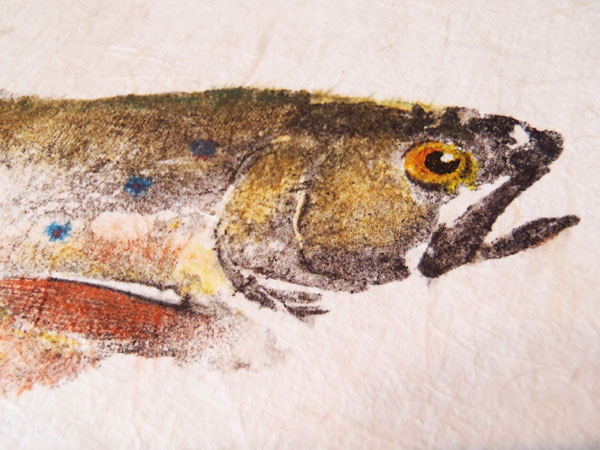
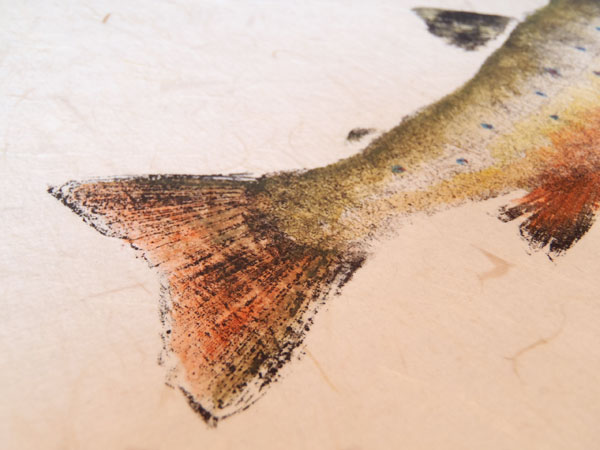
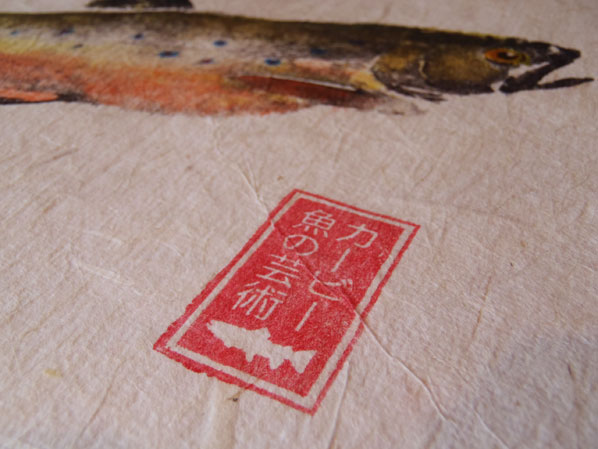
Like tenkara, gyotaku is very hands on and gives us a deeper connection to our sport. I like the fact that I now have another piece of tenkara art to hang on the wall of my gear room. I just have to get it framed.


I have always felt that the photography I do has a connection with the wabi sabi aesthetic was well as tenkara. Simple camera, that creates amazing photographs that embody imperfect beauty…
Those are great fish prints, I have always enjoyed them.
Brian
Brian, Holga is the tenkara of the photography world!
Sure is Jason!
Brian
I had never heard of gyotaku until you posted this. Since then, I have been reading and looking at other examples of gyotaku. Having done so, I can better appreciate the excellence of the print you now own. I am particularly impressed by the bi-colored caudal and pectoral fins in which the black spines are superimposed on a rusty-brown background. Very impressive piece, Jason.
These prints are very beautiful and you could not describe them better than you have,you are a natural author Jason..
Thanks for the compliment Jim!
A wonderful blog post, Jason! I would love to get my hands on a piece of gyotaku! As for other tenkara art, and I have not seen any yet, but I think watercolor paintings based on tenkara, especially depicting the outdoor settings, would be really neat. It would definitely fit into all that is wabi-sabi.
Can the fish be released after this process?
Hi Sydney, I highly doubt it. Not surprising though since Japan has a “catch & eat” fishing culture.
Unfortunately, no. The process requires careful cleaning, drying, and placement of the fish (i.e., removal of the slime while keeping all the scales, plugging holes and orifices, placement of the fins with the use of pins, removal of the eyes).
If you’re interested in seeing how fish prints are created check out Orchid Street Studio’s video guide at: http://www.youtube.com/watch?v=InpLfs4rasw.
Jason, great post. I love the way the Gyotaku prints capture the natural beauty and imperfections of the fish. I’d love to try it sometime! (Although I’m sure mine wouldn’t look nearly at beautiful!!)
If I tried it, it would turn out like this: http://www.nytimes.com/2012/08/24/world/europe/botched-restoration-of-ecce-homo-fresco-shocks-spain.html?_r=0
I thought I had posted this, but do not see it. Have you considered hanging the print as a wall scroll rather than in a frame? Maybe a rod at top and bottom, suspended by a cord from the ends of the top rod.
Hey Paul, this type of paper really needs to be behind UV glass on archival matting to preserve it. Plus the paper really isn’t flexible enough to make it a scroll although that would look neat!
rad.
Nice post, Jason. You posted a wonderful video created one of my favorite gyotaku artists (Heather Fortner) here in the US. I learned the direct method of gyotaku (putting ink on fish and laying paper/cloth on top, then rubbing or gently pressing) from my grandfather decades ago and like tenkara fishing, it’s been amazing to see it take off as an art form. To me, being out in Nature “in the flow” of things, is Art for the Heart and Soul!
For more wonderful information on the art of gyotaku and much more, people can go to:
http://www.natureprintingsociety.org
I am fortunate to travel to the International Fish Print Society outside of Tokyo to study with Mineo Yamamoto, who is often a guest instructor at the annual Nature Print Society conferences. He’ll be teaching the indirect method of gyotaku and in order to combine my love of painting and of tenkara fishing, my husband and I will be doing some tenkara fishing in Yamamoto sensei’s home town of Saitama, just a few days before the workshop begins! I am so jazzed!
Perhaps I can share my experience in both tenkara fishing and gyotaku printing with Yamamoto sensei on your blog after I get back!
I really enjoy reading your website and blogs and thank you for doing such an outstanding job.
Mahalo Jason!
Hi Robin, thanks. I would love to hear about it and to share your experiences on my blog. Please let me know after your trip and we can work something out. I’m sure my readers would be interested!