

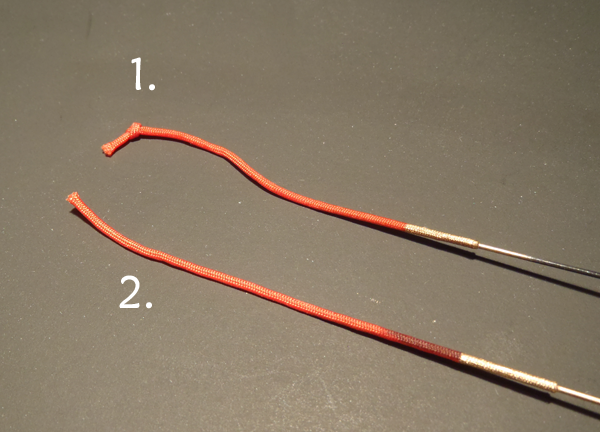
A reader recently asked me about the stopper knots on the ends of lilians (those red cords at the end of a tenkara rod where you attach the line). He said that some of the rods he purchased came with a knot and some didn’t. The question was if a knot is really necessary. Since I think other people might have this question, I thought it was worthy of a post.
First, let’s clarify one thing. Whether a rod you bought came with a knot (1.) or not (2.) is no indication of its intended use. It’s arbitrary. Some manufacturers do and some don’t (I assume either because they want to eliminate one more step in the manufacturing process or just because they want to let the customer decide if they want one or not). In fact, I’ve even purchased multiple rods from the same company and some had knots, some didn’t.
Having said that, the answer to the question is yes…and no.
If you’re using a girth hitch connection with a loop at the end of a line (the kind most traditional furled lines come with), then yes, you do need a knot. This connection relies on the cinched up loop butting up against the stopper knot. If you don’t have a knot, the line will slide right off the lilian.
But if you’re using a level line and the typical slip knot connection, you probably don’t need a knot. That’s because this connection doesn’t rely on a stopper. The line is held on by wrapping the lilian around the loop before cinching it up and friction keeps it in place.
One caveat: if you’re using a level line and don’t cinch it up tightly, it could slip and a stopper knot could potentially prevent the lilian from slipping off the line. If you choose not to use a knot in your lilian, I would recommend making sure you cinch it tightly before fishing and/or using 3 wraps instead of 2 just to be safe. I’ve lost lines to laziness when using this connection and have learned my lesson.
Since there is no disadvantage to having a knot in the lilian, I do use them on my rods. In fact, it’s the first thing I do when I get a new rod. That way, I can switch between furled and level lines easily (or more accurately, between lines that use a girth hitch connection and lines that use a slip knot connection).


My Soyokaze didn’t come with a knot. I lost a line and had to chase it down stream, I now use a knit, even though on that particular rod it prevents me from taking the rod completely apart.
The only time I’ve ever had to take a rod completely apart was to replace a broken tip so I don’t think it should be a problem.
I have three rods and have knots on each lillian. I look at it as an insurance policy to prevent slippage. In fact, I removed all of the “overhand” knots that came with them and replaced them with “figure eights”. Plenty of stopping power now! I dare those 6″ brookies to slide my line off now!!
my lilian tip is small loop.
Why a loop?
Thanks Jason, nice article.
@Sean: How do you like your Soyokaze? I haven’t had much chance to try mine out yet.
Hi Jason,
Belts & braces for me. I use both methods for connection. I am not real pretty chasing gear downstream, and it sort of puts the fish down!
@Curtis: I absolutely love the thing! I have the 9′ model and it works beautifully. Sometimes I wish I had the extra few feet but I normally fish streams no more then 5-6 feet across so it’s fine. I’ve caught everything from 6″ wild Brookies to my career high 21″ brown(it was intense) and the rod handled pretty well it seemed. Protects the tipper very well, is incredibly light, has great feel, and packs easily for hiking to a spot. I love it and highly recommend it. Theres a real good review right on TenkaraTalk too. And @Jason the only time I’ve wanted to take it apart was to dry it out after I dropped into a stream.
@curtis I was mistaken I thought there was a review on the Soyokaze but I must’ve seen it on another blog. Still a great rod though!
Sean, you weren’t mistaken. The review is here:
https://www.tenkaratalk.com/2012/05/daiwa-soyokaze-review/
For the record, I still don’t consider it a true tenkara rod and don’t really have the need for a short rod. But people who fish brushy streams seem to like it. Luckily, all the stream I fish are wide open so I can use 13′ or longer rods with no problem.
Ohhh okay I couldn’t find it. Same great review I was thinking of though!
And also I’m not sure what I consider what, I have a bass fishing rod that I’ve used in the ocean, I have a 5 weight freshwater fly rod I’ve used for bass, sand sharks, striper, and trout, and the Soyokaze that I’ve caught everything from trout to bass on. I just use the rod I’m in the mood to use and the style of fishing I plan on enjoying on any given day. Just like we use phones to go on the Internet but still all them phones instead of saying its a tablet or computer because it does more than just call. But that’s just my opinion and why. Either way, I’ll continue to love this blog and fishing of all sorts, keep up the good work Jason!
@kebarer: I can see how a loop-to-loop connection could be a convenience, both if one swaps lines frequently on the water and if one does a lot of experimenting (eg, playing with Western leaders just to see what gear can swap across, um, platforms). How do you make the loop? Whip it? Sew it? I can’t tie a knot with so little margin of error. (As to the other thread here: I also love my 10′ Soyokaze and don’t care a whit about what’s “true” tenkara.)
@Bruce Pencek ah,sew & wind wind with thread.sorry,I’m poor at English.If you do twitter,please see mine,I’ll post a photo.
The might sound very picky, but I am very curious abut the term lillian. Since there no letter L’s in the Japanese language where did the term lillian come from, and what does it really mean? Culturally, I don’ t see the appropriateness of using hard to define non Japanese terms in lieu of Japanese terms.
Hi Paul, it’s tricky but I’ll try to explain. The cord is made from a brand called “Lilly Yarn”. So that is the term used in Japan; however, it’s a mispronunciation so that’s how it became “lilian”. The Japanese “r” isn’t pronounced as a hard “r” as in English. It’s pronounced somewhere between an “L” and a soft “D” so that’s why they pronounce it as “lilian”.
Might seem strange but I personally like these little nuances of tenkara. It keeps in interesting to me.
Hi Jason:
What material you use to make the loop that conect your level line to the lillian?
Again thank you for your selfless help and willingness.
Regards.
Vasco
Hi Vasco,
I usually just tie a slip knot into the level line but sometimes I use 20 lb braided Dacron backing if I want to use a girth hitch connection.
I’m not using a knot on my new Shimotsuke Ten but I did take a lighter and singe the end of the lillian there is was a tiny bit frayed. Also with the double pass of the lillian through the level line I don’t see it coming lose. Now if I was to put a traditional line with a girth hitch it would be mandatory.
Hi Jason,
As a Tenkara newbie, I found this article very informative, thanks. In an article about Tenkara which appeared in California Fly Fisher (Aug/2012),the author suggests attaching a short 20 lb test mono to the lilian with a nail knot. Then tie a perfection loop on the mono so you could loop-to-loop connection with the level line. Sounds like a good idea, however could you offer your thoughts, or your readers thoughts on this before I consider trying it. Thanks and great website.
How about using a “hanging loop” instead of clinch knots.
It would seem to be better in terms of fly action.
Hi Allan, actually, I’ve tried that and observed both underwater. It made no difference in action. But that was with a sakasa kebari. When I fish larger flies in saltwater, I use a loop knot and it does make a difference (especially on weighted flies like Clousers or Crazy Charlies). It creates a nice undulating motion. But on weightless flies like sakasa kebari I see no difference.
Jason,
What are the pros and cons of tying a perfection loop in your lillian in order to have a loop to loop connection with your furled or level line?
Hi Tim. If you use a perfection loop you will have to run the line through the loop the entire length of the line which is less convenient than the tenkara connection which allows you to easily connect or disconnect the line without doing that or having to remove the fly. Does that make se sense ?
Jason,
Thanks. That doesn’t bother me, not much different time or effort wise than stringing up a regular fly rod with line, leader, and tippet. Bulk or hinging don’t seem to be an issue? How often do you switch between furled and level lines in a day on the water? Buying my wife a Tenkara rod for Christmas. Will experiment with the different attachments and lines this upcoming season.
Hi Tim, if you do a loop to loop knot it doesn’t hinge in my experience. I usually don’t switch lines during the day and I only use level fluorocarbon lines.
Hello Jason, Just out of interest, how is the actual lillian itself attached to the tip of a tenkara rod? I’ve used conventional whips to fish for European perch with very lightweight jigs, where they have pole elastic secured by a tiny bung in the end sections of the pole/whip, but I’ve never even seen a tenkara rod close up, let alone used one.
Hi Peter, look at this picture: https://www.tenkaratalk.com/wp-content/uploads/2014/04/P4190019.gif You can see that the lilian is usually attached with some wraps of thread covered in some type of glue or epoxy. Most manufacturers seem to use the same technique.
I disassemble and wipe each section down at the end of each “trip” – hence no knot. I haven’t lost a line yet, but it’s still early.